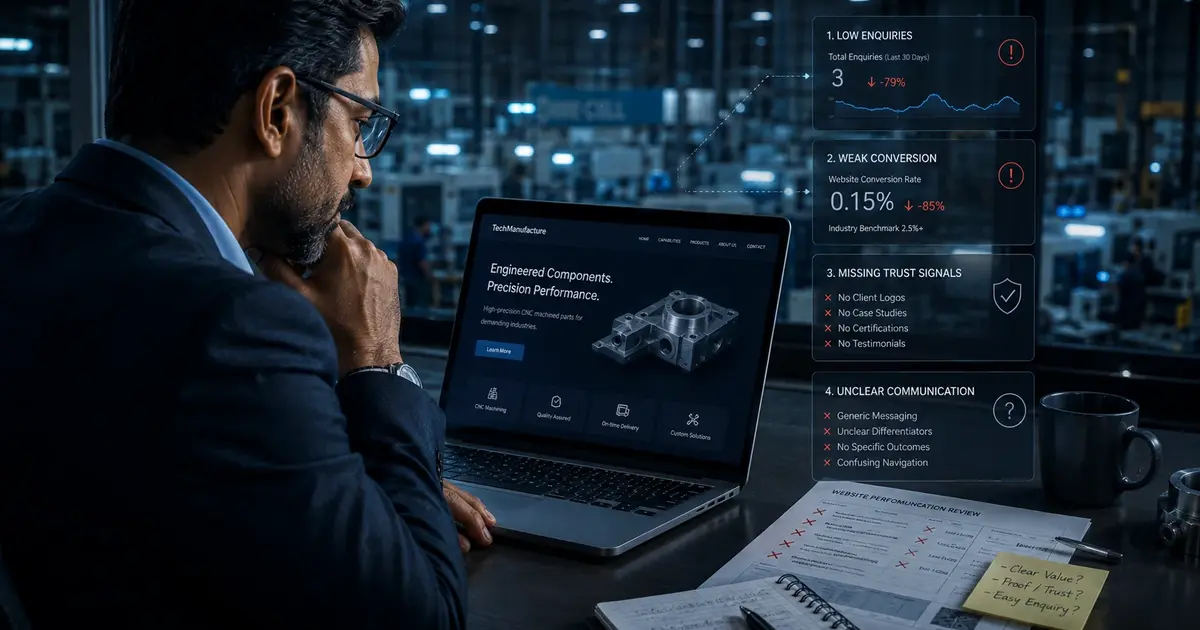
A website checklist for export businesses should begin with a commercial reality: an overseas buyer has more uncertainty to resolve than a local buyer.
They may be evaluating a supplier they have never met, in a country they have never purchased from, for a product that has technical, compliance, logistics or documentation requirements. The website therefore has a larger job than “looking professional”. It has to reduce enough uncertainty for a serious buyer to take the next step.
That means product clarity, technical evidence, manufacturing credibility, export readiness, market relevance and a dependable enquiry path. The strongest export websites make those things easy to verify without forcing a buyer to search across PDFs, old pages and generic company claims.
Website checklist for export businesses: start with the first 30 seconds
A buyer arriving from Google, LinkedIn, a referral or an exhibition follow-up should be able to understand the business quickly.
The homepage or landing page should make clear what the company manufactures or supplies, which buyer or industry it serves, what makes the capability commercially relevant and where the buyer should go next. Statements such as “quality is our priority” or “leading manufacturer and exporter” are too generic to do this work on their own.
If the business serves multiple product families, organise them around how buyers search and evaluate—not only around internal departments. Strong website communication reduces the amount of interpretation required from the buyer.
1. Product pages must answer commercial and technical questions
An export buyer rarely needs only a product name and photograph.
Depending on the category, they may need specifications, materials, sizes, grades, applications, performance characteristics, compatibility, standards, packaging, testing, documentation, options, customisation or order information. The page should explain enough to help the buyer decide whether the product belongs on the shortlist.
For technical products, downloadable data can be useful, but the webpage itself should still explain the product in readable language. Do not hide the entire buying argument inside a brochure.
2. Show manufacturing capability with evidence, not adjectives
“State-of-the-art facility” means very little without context.
A better capability section may show relevant production processes, equipment, capacity ranges, quality controls, testing, engineering support, customisation, industries served or manufacturing photographs. The purpose is not to create a factory tour. It is to give the buyer enough evidence to judge whether the supplier can support the requirement.
This is particularly important for manufacturing companies selling into markets where the buyer cannot visit the plant before the first commercial discussion.
3. Certifications and compliance should be easy to verify
Certificates are not decorative trust badges. They can be part of the buyer’s qualification process.
Display relevant certifications clearly and avoid implying that a certification covers products or processes it does not. Where appropriate, explain what the certification relates to. For regulated categories, link buyers to relevant technical or compliance documentation.
Quality systems such as ISO 9001 can matter because they communicate a structured approach to consistent delivery and continual improvement. The International Organization for Standardization’s ISO 9001 overview is useful context for what the standard is intended to support.
4. Make international sales readiness visible
A buyer should not have to guess whether you are prepared to sell internationally.
Useful signals can include markets already served, export packaging capability, relevant shipping terms, documentation support, international standards, preferred enquiry details and the languages in which your team can respond. Do not publish confidential commercial terms simply to appear export-ready.
The U.S. International Trade Administration describes website internationalization as a deliberate process of making a site effective for overseas customers, including search discoverability, performance and market usability. Its three-stage website globalization guidance is a useful framework for thinking beyond a generic exports page.
5. Use market-specific pages only where buyer context actually changes
Creating a country page for every market may appear to be an SEO shortcut. Thin pages usually create little value for a buyer.
A market page is useful when it adds something specific: standards, applications, sector priorities, language, terminology, route-to-market, shipping context or commercial proof relevant to that geography. It should show that the exporter understands the market without pretending to have an office where it does not.
TSPACE’s own market architecture follows this principle: distinct pages exist where the buyer context is commercially meaningful.
6. Make the company easy to verify
Overseas buyers frequently perform basic due diligence before contacting a supplier.
Your company name, legal identity, address, contact information, history, leadership or team information, manufacturing location and professional profiles should be consistent enough to inspire confidence. If the website says one thing while search results, social profiles or directories say another, the inconsistency creates doubt.
This is one reason digital presence cannot be reduced to website design. Buyers evaluate the wider footprint.
7. Replace generic testimonials with relevant proof
Anonymous praise such as “excellent quality and service” is weak evidence.
Where confidentiality permits, stronger proof can include named clients, sectors served, case examples, applications, years of association, repeat-business indicators, project types or verifiable testimonials. When client names cannot be disclosed, explain the situation without inventing vague success stories.
The goal is not to fill a page with logos. The goal is to answer the buyer’s question: Has this supplier successfully handled something like what we need?
8. Build an RFQ path that captures useful context
A single “Contact Us” form can be too weak for technical export enquiries.
The form should make it easy to specify product, application, quantity or approximate requirement, destination market and any relevant technical details. File upload may be useful for drawings, specifications or RFQs where the product category requires it.
Do not make the form unnecessarily long. Ask for information that actually changes the way the enquiry is handled.
9. Plan what happens after the form is submitted
The website has not converted simply because the form was submitted.
Who receives the enquiry? How quickly is it acknowledged? Who owns the country or product? How is the lead qualified? Is the source recorded? Are reminders created? Is the outcome visible later?
The lead response quality layer is what turns the export website from a digital brochure into a commercial system.
10. Technical performance affects trust too
Slow pages, broken PDFs, unreadable mobile layouts, insecure forms and outdated content all create friction. The buyer may not diagnose the problem technically. They simply experience the company as harder to deal with.
Performance should therefore be treated as part of credibility. Images should be optimised, forms should work on mobile, important documents should be accessible and the site should not depend on intrusive popups to create an enquiry.
11. Help search and AI systems understand the business accurately
Clear page titles, useful headings, descriptive internal links, relevant schema, product information and consistent entity details make the site easier to interpret. This supports both traditional search visibility and newer AI-assisted buyer research.
The objective is not to manipulate search systems. It is to structure the site so a buyer question can be matched to a clear, credible answer. TSPACE’s Search & AI Visibility work applies this principle across the wider site architecture.
A strong export website reduces uncertainty before sales gets involved
The best test is not whether the website looks modern. Ask whether a serious overseas buyer can independently answer the questions they need before contacting you.
Can they understand the product? Verify the company? Judge capability? Find technical evidence? See international readiness? Know how to enquire? Trust that somebody will respond?
When the answer is yes, the website becomes more than a marketing asset. It becomes part of the exporter’s market-entry and buyer-conversion infrastructure.
Need your B2B business to look clearer and more trustworthy online?
Share your business context with TSPACE Global and we’ll suggest the most relevant next step.