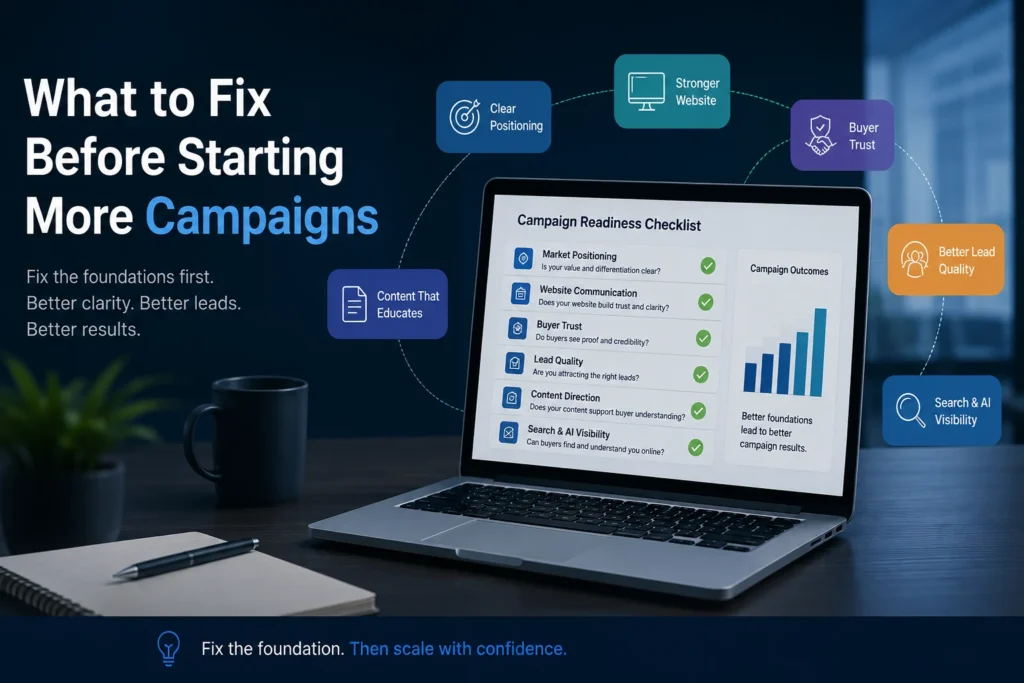
The best lead generation channels for industrial B2B companies are not necessarily the newest ones. They are the channels that match how industrial buyers actually discover, evaluate and shortlist suppliers.
That process is rarely instant. A plant head may notice a supplier at an exhibition. An engineer may later search for a technical solution. Procurement may check the company website. A director may review the supplier on LinkedIn. Weeks later, someone sends an RFQ.
If marketing measures only the final click, much of the buying journey disappears. If sales depends on only cold calls or referrals, the business becomes vulnerable when those channels slow down.
The stronger approach is a connected demand system: several channels doing different jobs, all leading to a credible digital presence and a measurable enquiry process.
How to evaluate lead generation channels for industrial B2B companies
Before choosing channels, separate three different objectives.
Demand capture reaches buyers already searching for a supplier or solution. Demand creation helps buyers discover a problem, application or capability before they are actively searching. Demand conversion turns interest into an RFQ, meeting, technical discussion or qualified enquiry.
No single channel is equally good at all three.
McKinsey’s ongoing B2B research is useful context here. Decision-makers now move across a mix of in-person, remote and digital channels, using many touchpoints during the buying journey. A supplier therefore needs consistency across channels rather than a bet on one platform. McKinsey’s B2B Pulse research describes this increasingly omnichannel behaviour.
1. Organic search: capture buyers already researching a problem
Search remains one of the strongest channels for industrial businesses because buyer intent can be very specific.
A prospect may search for a machine type, material, specification, process, application, chemical grade, lubricant use case, component, supplier category or troubleshooting question. If the website has useful pages built around those needs, search can introduce the business before a salesperson knows the buyer exists.
Industrial SEO works best when it reflects product and application logic rather than forcing broad keywords into generic pages. Useful technical content also supports Search & AI Visibility because it gives search and answer systems clearer information about what the company actually does.
2. Paid search: create speed around high-intent terms
Google Ads can be valuable when buyers already know what they need and search volumes are commercially meaningful.
The weakness is that industrial keywords can be ambiguous. A term may attract students, consumers, job seekers, small traders or buyers whose quantity is far below the company’s minimum commercial requirement.
That means the landing page and campaign structure matter as much as the keyword. Separate product families, applications, geographies and buyer types where useful. Use negative keywords. Make minimum requirements clear when appropriate. Track qualified enquiries rather than celebrating every form submission.
Paid media performs better when the underlying campaign direction is tied to a real business objective.
3. LinkedIn: build visibility around expertise and decision-makers
LinkedIn is often misused by industrial companies in two opposite ways: either as a notice board for festivals and awards, or as a mass-outreach tool sending identical messages to hundreds of prospects.
Its stronger role is authority and targeted reach.
Technical insight, application stories, project learning, product education, leadership perspective and operational proof can help decision-makers understand the company before a direct approach. Targeted outreach can then work better because the prospect has something credible to verify.
This is especially useful for engineering, automation, machinery, export and high-ticket B2B businesses where the buyer group is identifiable but the sales cycle is long.
4. Technical content: turn internal knowledge into buyer confidence
Industrial companies often sit on years of valuable knowledge that never reaches the website.
Sales teams answer the same questions repeatedly. Engineers solve recurring application problems. Service teams know why installations fail. Product managers understand trade-offs between specifications. That knowledge can become articles, application notes, comparison guides, FAQs, videos and case-based content.
Good technical content is not written to “post regularly”. It helps a buyer make progress in a decision.
TSPACE’s Content That Supports Growth approach treats content as part of the buying journey rather than as a publishing calendar.
5. Exhibitions and industry events: strongest when digital follows the meeting
Trade fairs remain valuable in many industrial sectors because complex products and high-value relationships benefit from physical interaction.
The problem is not the exhibition. It is what happens around it.
Before the event, digital campaigns and outreach can help priority prospects know the company will be there. During the event, lead capture should record context rather than collect only business cards. After the event, tailored follow-up pages, technical material, remarketing and CRM tasks can keep the conversation moving.
An exhibition should become one touchpoint inside a longer commercial journey—not a three-day island.
6. Dealers, distributors and strategic partners: extend reach through trusted networks
For many industrial categories, the fastest route into a geography or customer segment is through a partner already serving that market.
Distributor acquisition itself can be treated as a lead-generation programme. The business needs a clear partner proposition, a dedicated funnel, qualification criteria and a system for following opportunities by territory.
For companies building channel networks, see TSPACE’s Dealer & Distributor Businesses focus and the related insight on attracting dealers and distributors through digital marketing.
7. CRM-led nurture, email and remarketing: convert the demand you already paid to create
Industrial sales cycles often outlast the original marketing campaign.
A buyer can be interested today but unable to purchase until a project is approved, a budget is released, an existing contract ends or a technical trial is completed. If every lead is treated as “hot now or dead”, the business wastes demand it already created.
CRM-led nurture does not mean sending a newsletter every week. It means retaining context: what the buyer needed, what stage the requirement reached, when to follow up, which technical information is relevant and what changed since the last conversation.
Remarketing can support this by keeping the company visible to people who already visited important pages or interacted with campaigns, but the message should add value rather than repeat “contact us”.
The website is the common layer beneath all seven channels
Every channel eventually creates a credibility check.
A buyer who hears about the company at an exhibition may later visit the website. A LinkedIn prospect may search the brand name. A distributor prospect may inspect product pages. A paid-search lead may read the About page before filling the form.
If the website does not explain the business clearly, every acquisition channel has to work harder. That is why industrial product businesses need a digital presence that reflects the strength of the real operation.
Do not choose channels by popularity. Choose them by the buyer journey.
An industrial company selling standard consumables to thousands of small businesses may need a different mix from a company selling engineered equipment through six-month technical evaluations.
Map how the buyer becomes aware, what they research, who influences the decision, what evidence they need and how an enquiry becomes an order. Then assign channels to those jobs.
The most resilient industrial lead-generation system is not the one with the most platforms. It is the one where each channel has a clear role, the website supports buyer confidence, and sales can see what happens after the enquiry arrives.
Need your B2B business to look clearer and more trustworthy online?
Share your business context with TSPACE Global and we’ll suggest the most relevant next step.